


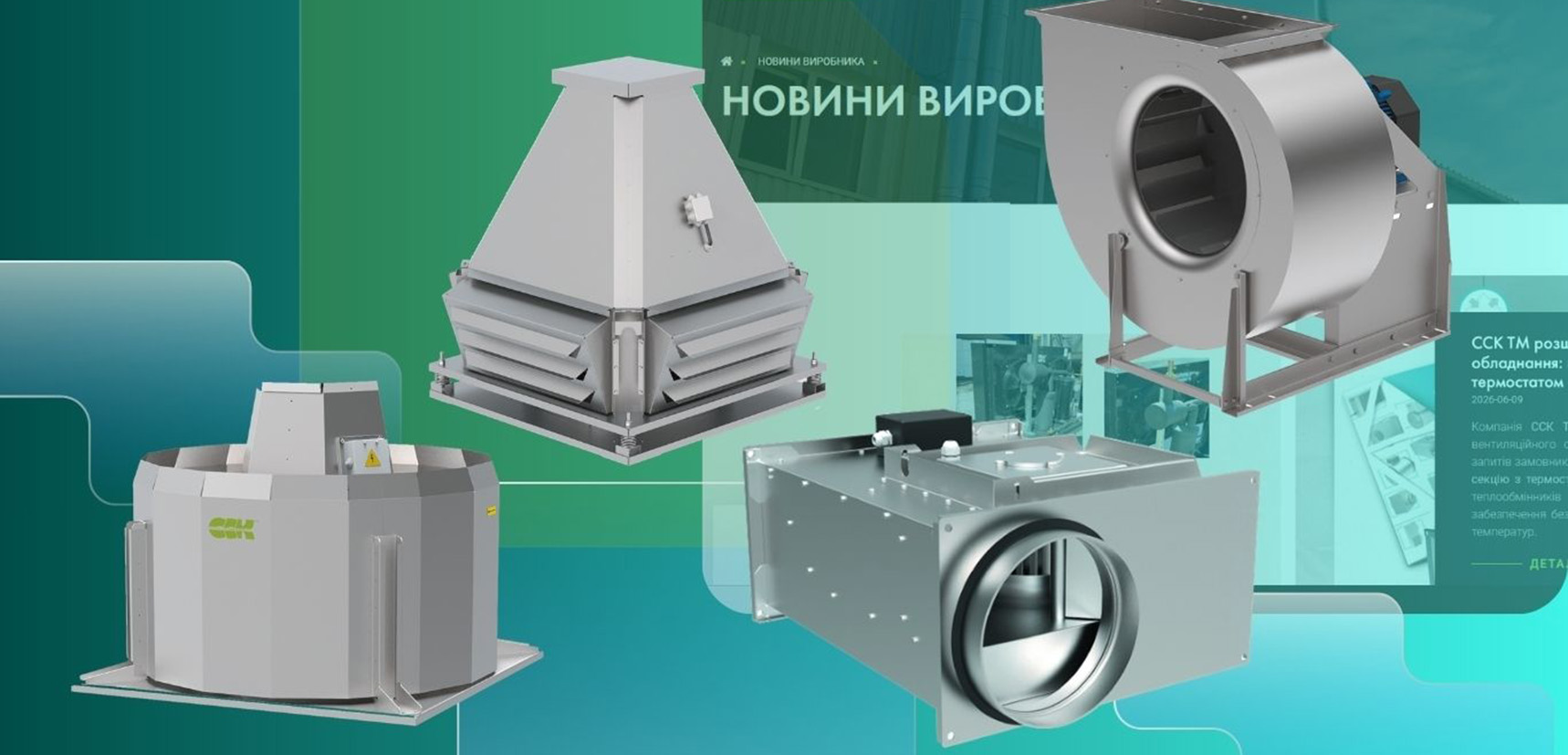
The correct selection of an industrial fan is essential for ensuring efficient ventilation, reliable operation of industrial processes, and overall production safety. Industrial fans are responsible for maintaining an optimal indoor climate, removing harmful emissions, cooling equipment, and generating the required airflow and pressure conditions. Fan selection should take into account numerous factors, ranging from the technical characteristics of the equipment itself to the specific operating conditions of the facility.
If you want to select a fan that fully meets the requirements of your production process, it is important not only to understand the different types of fans and their applications, but also to become familiar with the key technical parameters, aerodynamic selection methods, and operating requirements for various industrial environments. SCCK TM LLC, a leading Ukrainian manufacturer of ventilation equipment and automation systems, is ready to share expert recommendations to help you make the right choice.
Overview of Industrial Fan Types and Their Applications
Industrial fans differ in design, operating principle, and area of application. The main types of industrial fans and their intended uses are described below.
CCK TM Axial Fans
Axial fans generate a directed airflow parallel to the axis of the impeller and are designed to move large volumes of air at relatively low system resistance. Due to their high airflow capacity, compact design, and energy efficiency, they are widely used in general ventilation systems, smoke extraction systems, air pressurization systems, process equipment cooling, and ventilation of large facilities.
CCK TM axial fans are available in various configurations and are selected according to the required airflow rate and operating conditions.
CCK TM Centrifugal (Radial) Fans
Centrifugal fans operate by changing the direction of the airflow: air enters the impeller axially and is discharged at a 90-degree angle. This design enables significantly higher pressure generation compared to axial fans.
CCK TM centrifugal fans are widely used in systems with extensive duct networks, high aerodynamic resistance, as well as in industrial ventilation, dust extraction, and process ventilation applications. Depending on the intended use, the equipment can be manufactured in standard industrial, dust-handling, kitchen ventilation, explosion-proof, or fire-rated versions.
CCK TM Inline Duct Fans
Inline duct fans are designed for installation directly within the ductwork and represent one of the most versatile solutions for supply and exhaust ventilation systems. They feature compact dimensions, low noise levels, and easy installation.
CCK TM inline fans are manufactured for both round and rectangular ducts and are widely used in administrative, commercial, residential, and industrial buildings.
CCK TM Roof Fans
Roof fans are intended for installation directly on the roof of a building and are used in exhaust and supply-exhaust ventilation systems. This arrangement reduces duct lengths, optimizes the use of internal space, and simplifies maintenance of the ventilation system.
CCK TM roof fans provide efficient air extraction from industrial facilities, warehouses, retail buildings, office buildings, and public facilities. Depending on the application, the equipment may be used for general ventilation, removal of heated air, or as part of smoke extraction systems.
The fan design includes protection against atmospheric exposure, resistance to temperature fluctuations, and long-term operation in outdoor conditions. A wide model range allows selection by airflow capacity, pressure, and functional purpose for projects of any complexity.
CCK TM fans cover all major sectors of modern ventilation engineering and enable efficient solutions for residential, commercial, industrial, and special-purpose facilities while ensuring reliability, energy efficiency, and compliance with applicable standards.
Each fan type has its own purpose and is optimal for specific operating conditions. For example, axial fans are suitable for ventilating production workshops with large air volumes, whereas centrifugal fans are generally preferred for ventilation systems with higher pressure losses and greater system resistance.
Explore the ventilation equipment portfolio of CCK TM LLC to select a fan that matches the unique requirements of your facility.
Axial vs. Centrifugal Fans: Key Differences and Which Fan Is Better?
A common question is: which fan is better—axial or centrifugal? To answer it, it is necessary to compare the main characteristics and operating differences of these two fan types.
Fan Type | ||
Exhaust Fans | Removal of contaminated air, gases, fumes, and dust particles | Can be equipped with filters and silencers to improve air quality and reduce noise levels |
Cooling Fans | Heat dissipation and maintenance of optimal equipment operating temperatures | Widely used in HVAC systems, refrigeration equipment, and industrial cooling applications |
Supply Air Fans | Delivery of fresh outdoor air to occupied spaces | Used in mechanical supply ventilation and air-handling systems |
Axial fans are versatile devices designed to move large volumes of air while operating against relatively low system resistance. Centrifugal fans, on the other hand, are better suited for applications requiring higher pressure, such as dust extraction systems and complex duct networks with significant aerodynamic resistance.
Key Characteristics of Industrial Fans: What to Consider
When selecting an industrial fan, it is important to evaluate a combination of technical parameters that determine its efficiency and suitability for specific operating conditions.
The main fan characteristics include:
- Airflow capacity (air volume flow rate) – the amount of air moved by the fan, typically measured in m³/h.
- Pressure – static or total pressure generated by the fan, measured in Pa (Pascals) or mm H₂O.
- Motor power – affects energy consumption and overall performance.
- Noise level – an important factor for compliance with occupational health requirements and personnel comfort.
- Rotational speed – the motor speed that drives the fan impeller, usually measured in RPM.
- Construction material – determines resistance to corrosion and aggressive operating environments.
- Installation type – wall-mounted, floor-mounted, inline duct installation, etc.
What determines fan performance characteristics? Primarily, they depend on the blade design, blade angle, rotational speed, and impeller diameter.
How to Select a Fan Based on Airflow Capacity and Pressure
Successful fan selection begins with determining the required airflow capacity and pressure.
The selection process typically includes the following steps:
- Determine the required airflow rate (m³/h).
- Calculate the resistance of the ductwork and ventilation system (Pa).
- Select a fan capable of providing the required airflow at the specified pressure.
- Verify motor power and rotational speed requirements.
- Consider environmental conditions and operating requirements.
Fan Selection Checklist
- Required airflow rate and system pressure have been calculated.
- Fan aerodynamic performance matches system requirements.
- Noise level and housing material have been evaluated.
- Equipment has been selected with an adequate performance reserve.
- Automation and control requirements have been considered.
Selecting a Fan Based on Airflow Capacity: Practical Recommendations
The operating environment has a significant impact on fan service life and efficiency. When selecting equipment, consider the following factors:
- Air temperature – elevated temperatures require fans manufactured from heat-resistant materials.
- Environmental aggressiveness – the presence of dust, chemicals, or high humidity influences the selection of housing and impeller materials.
- Type of contaminants – dusty or sticky environments require fans with specially designed airflow passages and cleaning provisions.
- Operating mode – continuous operation or intermittent duty cycles affect motor selection and maintenance requirements.
Types of Fans for Industrial Ventilation and Their Applications
Depending on the requirements of a specific industrial facility, specialized fan designs may be selected to ensure optimal system performance, reliability, and energy efficiency.
Fan Type | Main Function | Typical Applications |
Exhaust Fans | Removal of contaminated air, gases, and dust particles | May be equipped with filtration and noise attenuation devices |
Cooling Fans | Dissipation of heat and maintenance of optimal equipment temperatures | Commonly used in HVAC and industrial cooling systems |
Supply Air Fans | Delivery of fresh outdoor air to indoor spaces | Applied in mechanical supply ventilation systems |
Types of Industrial Fans for Ventilation Systems and Their Applications
Depending on the operational requirements of an industrial facility, specialized fan types are selected. Each fan category features specific design characteristics and aerodynamic properties that must be considered during the system design stage.
What Determines Fan Performance and How to Calculate It
Fan performance is one of the most important parameters when selecting ventilation equipment. Airflow capacity depends on several technical factors:
- Impeller diameter – a larger impeller increases the volume of air moved by the fan.
- Rotational speed – the higher the fan speed, the greater the airflow rate.
- Blade design – blade shape and pitch angle directly affect airflow characteristics and overall efficiency.
- System resistance – duct length, bends, dampers, filters, and other components increase pressure losses and reduce overall system performance.
For accurate fan selection, engineers use performance curves that illustrate the relationship between airflow rate and pressure, as well as specialized airflow simulation and system modeling methods.
The chart below illustrates typical relationships between fan airflow performance, rotational speed, and impeller size.
Practical Recommendations for Selecting an Industrial Fan from CCK TM
CCK TM LLC offers high-quality industrial fans and ventilation components designed to meet the requirements of both Ukrainian and international markets:
- In-house manufacturing – complete quality control throughout all production stages.
- Extensive product range – a wide selection of fan types and accessories for virtually any application.
- Customized engineering support – our specialists assist with calculations, equipment selection, and system optimization.
- Technical support and after-sales service – professional consultation regarding operation, maintenance, and automation solutions.
Frequently Asked Questions About Industrial Fan Selection and Operation
How can I determine which fan is best suited for my application?
First, define the required airflow capacity and static pressure, then evaluate environmental conditions such as temperature, humidity, dust concentration, and chemical exposure. Based on these factors, select the appropriate fan type (axial, centrifugal, duct, roof-mounted, etc.).
Can one fan be used for different applications?
Industrial fans are typically designed for specific operating conditions. While some versatile solutions exist, using a fan outside its intended application may reduce efficiency, reliability, and service life.
How often should industrial fans be serviced?
Maintenance intervals depend on operating conditions and manufacturer recommendations. In most cases, inspection and servicing every 6–12 months are recommended, including checks of impellers, bearings, motors, and electrical connections.
How does automation improve ventilation system performance?
Automation enables real-time control of fan operation, optimizes airflow according to demand, reduces energy consumption, and improves overall system reliability and efficiency.
Which parameter is more important when selecting a fan: airflow capacity or pressure?
Both parameters are equally important. The selected fan must provide the required airflow while overcoming the total resistance of the ventilation system. Therefore, airflow capacity and pressure should always be evaluated together during the selection process.